
What Are Harrison County Court Dockets
A court docket is the official list of cases set before a judge. In Harrison County, each trial court keeps its own docket. The docket marks when a hearing is scheduled and where it will be heard. It records the case number, the party names, the courtroom, the date, the time, and the presiding judge. Think of it as the court calendar. It tells you what is set and when, not the full story of a case. The county counts cases by type, so a docket may read 0 Civil Cases Scheduled or 1 Chancery Court Cases Scheduled for a given day.
A docket is not the same as a full case file. The file holds pleadings, motions, orders, and decrees. The docket holds the schedule and the case identifiers. Harrison County's online docket pages show schedule data only. Documents are not downloadable from a docket page. For the papers behind a case, the clerk of that court or the state e-filing system is the right path.
Dockets help you track a case. They also confirm a court date fast.
How to Search Harrison County Dockets Online
Harrison County hosts four online docket searches, one for each main trial court. Each opens to the current day's scheduled cases by default. You can search by last name or by date. Pick the court that matches your case type before you start, because there is no single box that covers every court at once.
- Identify the court level first. A felony or major civil case is usually Circuit Court. A divorce, estate, or guardianship is Chancery Court. A lower civil claim or county misdemeanor may be County Court. A sheriff or Highway Patrol ticket, a DUI, or a county ordinance matter often starts in Justice Court.
- Open the matching search: the Circuit Court docket search, the County Court docket search, the Chancery Court docket search, or the Justice Court docket search.
- Enter a last name or choose a hearing date. A Chancery name search needs at least the first three characters of the party name. A Chancery date search returns current and future settings only.
- Read the scheduled entries. Note the case number, the courtroom, the date and time, and the judge.
- For the full file or documents, contact the clerk of the court or use the state e-filing system.
Docket Search Fields by Court Level
The four docket searches share one simple form. You search by last name, by date, or both. The year dropdown leans toward the present and future, which matters most for the Chancery tool. The Chancery Court page from the Chancery Clerk explains the three-character name rule and notes that the docket shows courthouse, courtroom, date and time, case number, parties, and judge.
| Field Label | Type | Required | Options / Format Notes |
|---|---|---|---|
| Search by Last Name | Text | Optional | Chancery name search needs at least the first three characters of the party name. |
| Search by Date - Month | Dropdown | Optional | Month options 1 through 12. |
| Search by Date - Day | Dropdown | Optional | Day options 1 through 31. |
| Search by Date - Year | Dropdown | Optional | Circuit, County, and Chancery list current and future years such as 2026 to 2028; Justice showed 2024 to 2028. |
| Search / Submit | Button | n/a | Rendered as an image button on the page. |
| Current-Day Cases | Default result | n/a | Today's scheduled cases display by default below the form. |
Note: A Harrison County Chancery date search returns only current and future hearing settings, so it will not pull a past Chancery hearing from the docket page.
Courts That Publish Dockets in Harrison County
Harrison County publishes online dockets for its four main trial courts. The work splits across Judicial District 1 in Gulfport and District 2 in Biloxi. Courtroom labels in the results name the side of the county, such as Gulfport Circuit Courtroom 2 or Biloxi County Courtroom 1. Each court posts a different mix of hearings.
- Circuit Court posts felony, major civil, and appeal hearings.
- County Court posts lower civil claims and some criminal and youth settings.
- Chancery Court posts divorce, custody, estate, guardianship, and commitment hearings.
- Justice Court posts traffic, DUI, county ordinance, and initial-appearance settings.
The Justice Court page adds a useful detail for criminal cases. It states that all felony cases are first heard in Justice Court for an initial appearance, and judges hold jail court three times a week so an arrested person sees a judge within three days. The county's Justice Court page explains how that court handles tickets and felony first appearances.
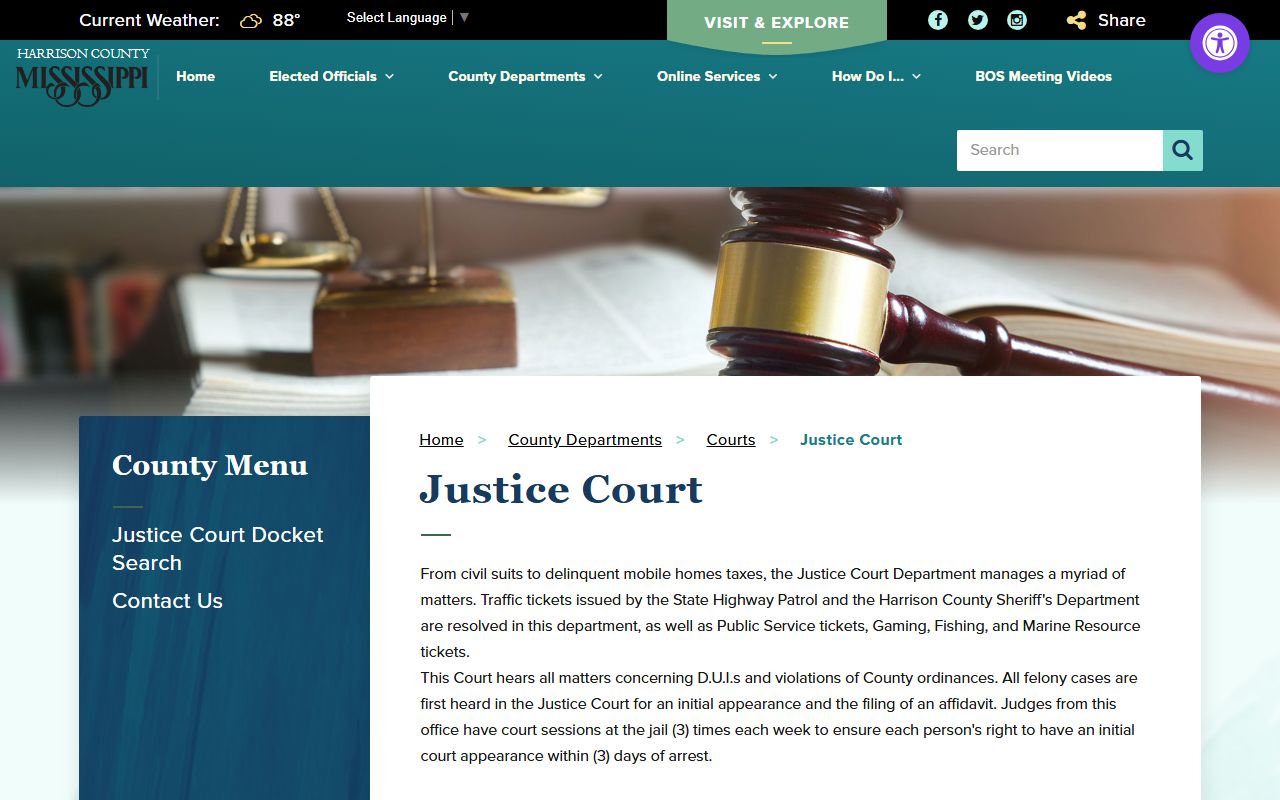
Justice Court hears tickets from the Mississippi Highway Patrol and the Harrison County Sheriff's Department, so its docket fills with traffic and DUI settings. Municipal courts in cities like Gulfport and Biloxi run their own systems, and Youth Court matters stay restricted from the public docket tools.
What a Harrison County Docket Entry Shows
Each docket line is short. It carries the basics of one scheduled hearing. A Chancery example from the county site read WORK DAY, case 24CH1:26-CM-09998, Gulfport Chancery Courtroom 1, dated 6/22/2026 at 9:00 AM, with the Honorable Jim Persons presiding. The fields below appear in that view.
| Field | What It Shows |
|---|---|
| Case Caption / Event | Party names or a hearing label, such as ALLY BANK V. SEATON. |
| Case Number | Court code, such as 24CO2:26-CV-00560 or 23CI1:25-CR-00170. |
| Courtroom | Location and district, such as Biloxi County Courtroom 1. |
| Date and Time | Hearing day and start time, shown as mm/dd/yyyy and a clock time. |
| Presiding Judge | The chancellor or judge set to hear the case. |
| Case Count by Category | A tally line, such as 0 Civil Cases Scheduled. |
The docket page stops there. It does not show pleadings, attorneys of record, financial detail, or the case disposition. Those live in the clerk's file. The view also marks the end of the scheduled list, so you know when you have seen every case set for that day.
How to Read a Harrison County Docket
Docket terms can read like code. A short glossary clears up the words that show up most. Case numbers also follow a pattern, where the leading code points to district, court, year, and case type, though the county does not publish an exact key for the public.
- Docket
- List of scheduled hearings or procedural entries in a case.
- Continuance
- Postponement of a hearing or trial to a later date.
- Arraignment
- Hearing where charges are read and a plea is entered.
- Bench warrant
- Warrant a judge issues, often after a failure to appear.
- Capias
- Order to take a person into custody, often after a missed date or unpaid fine.
- Disposition
- Final outcome of a charge or case.
Note: A bench warrant or capias listed on a docket usually points to a missed court date, and it can stay active until the person appears or the court clears it.
Docket vs. the Full Case File
The docket and the case file serve different needs. One tracks the schedule. The other holds the record. Knowing which one you need saves a trip to the wrong office.
| Docket | Full Case File | |
|---|---|---|
| Format | List of scheduled entries | Pleadings, motions, orders, decrees |
| Access | Free online by court level | Clerk counter, MEC/PAMEC, or fee |
| Shows | Date, courtroom, judge, case number | Charges, plea, disposition, sentence, documents |
| Best for | Confirming a hearing | Legal review and evidence |
For e-filed documents, Mississippi Electronic Courts and its public PAMEC access handle trial-court records for the Circuit, County, and Chancery courts. The Circuit Clerk and Chancery Clerk hold the paper files and certified copies. Wider guidance on pulling files sits with the broader Harrison County court records options, which cover every clerk channel.
Harrison County Intervention Court Calendar
Harrison County also runs a problem-solving court with its own calendar. The Second Circuit Intervention Court serves Harrison, Hancock, and Stone Counties. It offers a therapeutic alternative to standard felony prosecution. A spot is not guaranteed, since each person must be evaluated, screened, and approved first.
The county's Second Circuit Intervention Court page describes the program and who it serves.
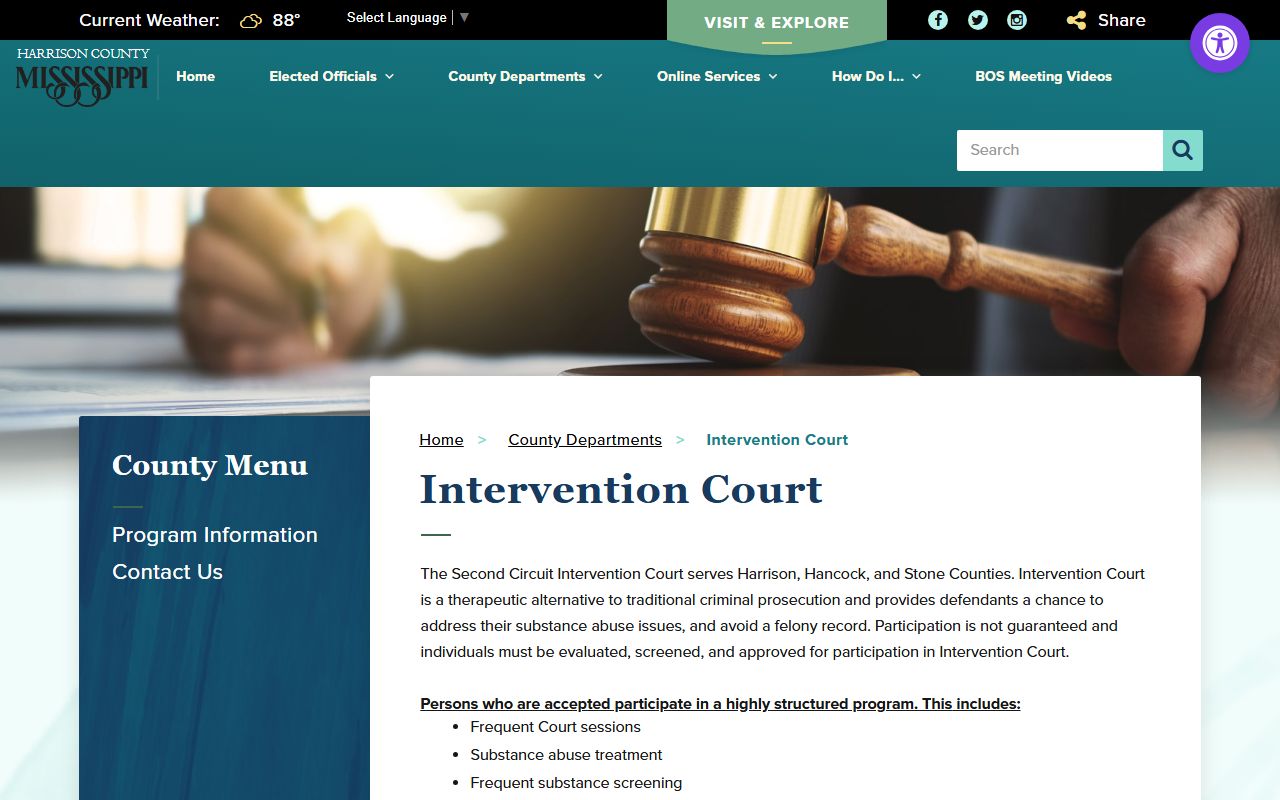
The court aims to change addictive behavior and help adults reintegrate into the community. It is also known as Drug Court. The program program description explains how it works.
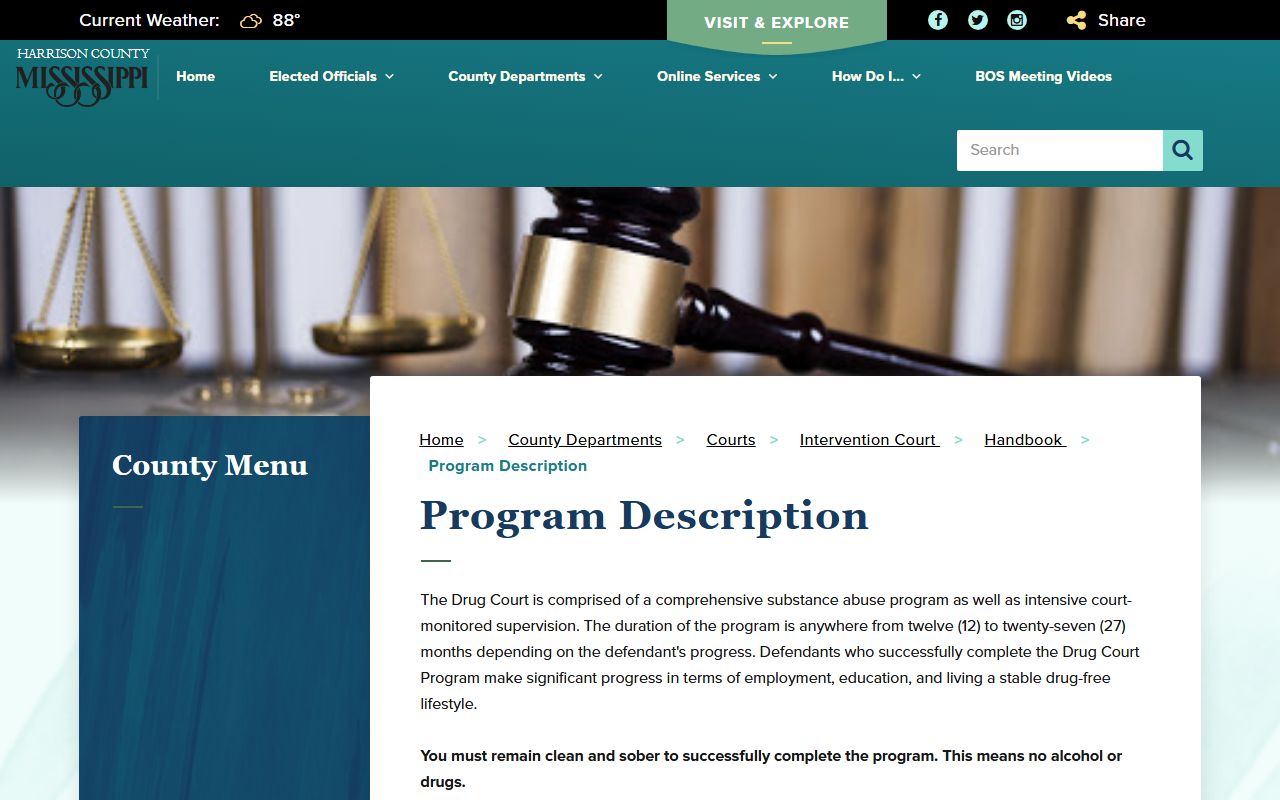
Drug Court combines substance-abuse programming with intensive, court-monitored supervision. The program runs 12 to 27 months, depending on a person's progress. Its judge supervision page sets the calendar.
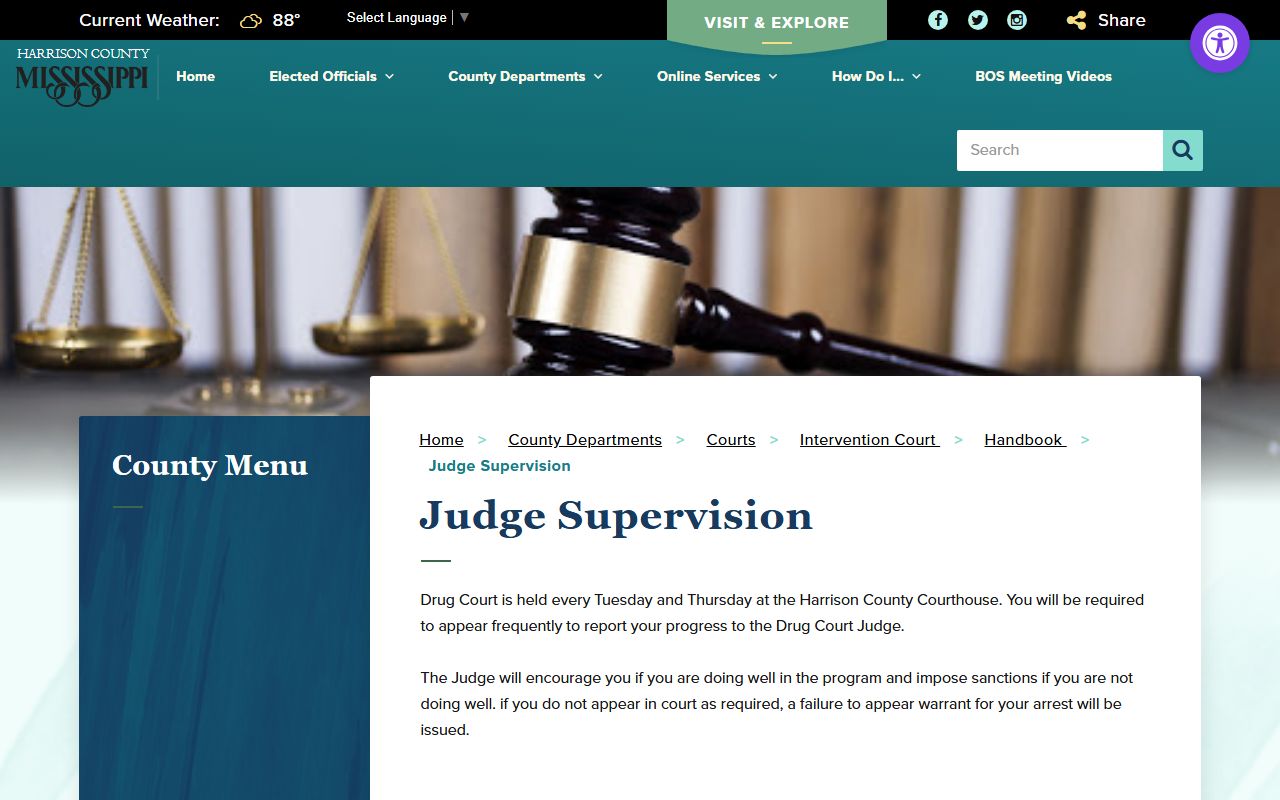
Drug Court is held every Tuesday and Thursday at the Harrison County Courthouse. A participant who fails to appear can draw a failure-to-appear warrant.
Drug Court Rules and Services in Harrison County
The program sets firm rules and offers real support. Missed appearances and failed drug tests carry sanctions. The program rules page lists what a participant can face.
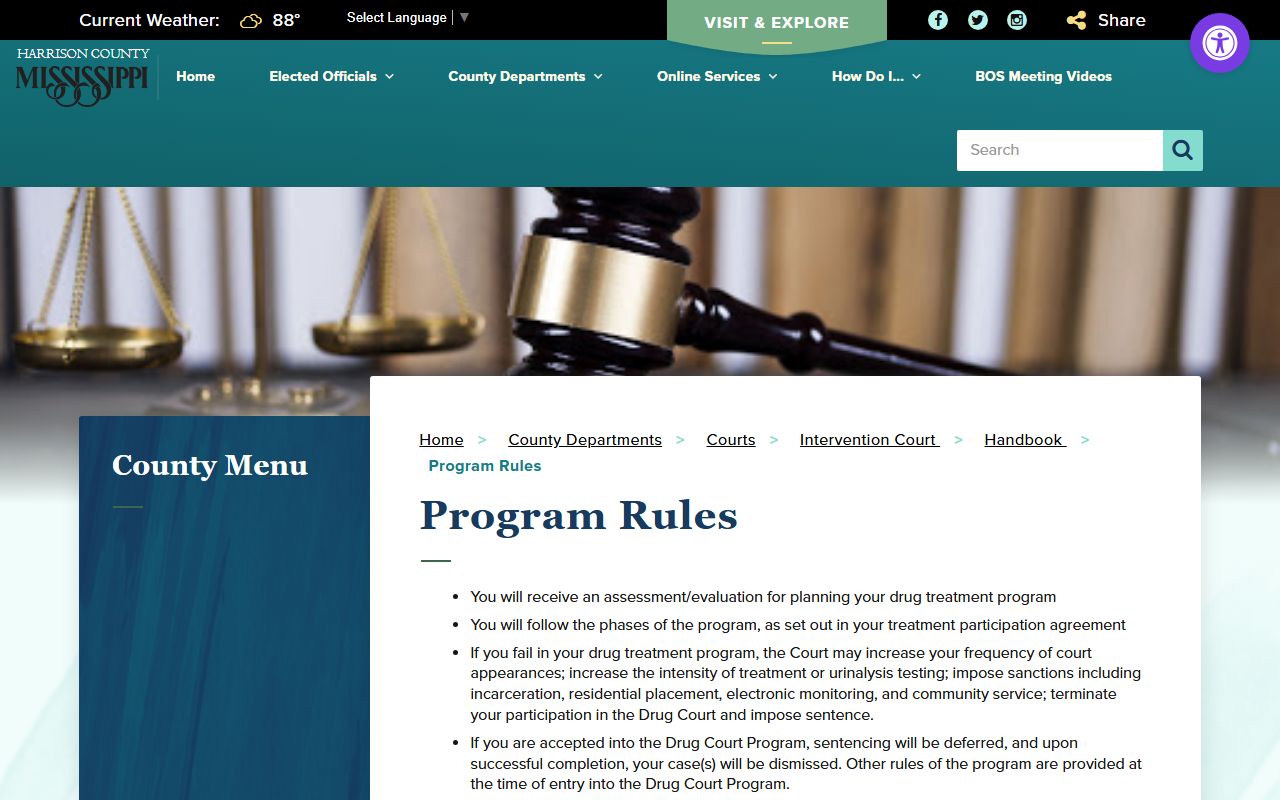
Sanctions can escalate step by step. They range from extra hearings up to jail time.
- Increased court appearances.
- More intense treatment or urinalysis.
- Incarceration or residential placement.
- Electronic monitoring or community service.
- Termination from the program and sentencing.
Support runs alongside the rules. The services page outlines the help available.
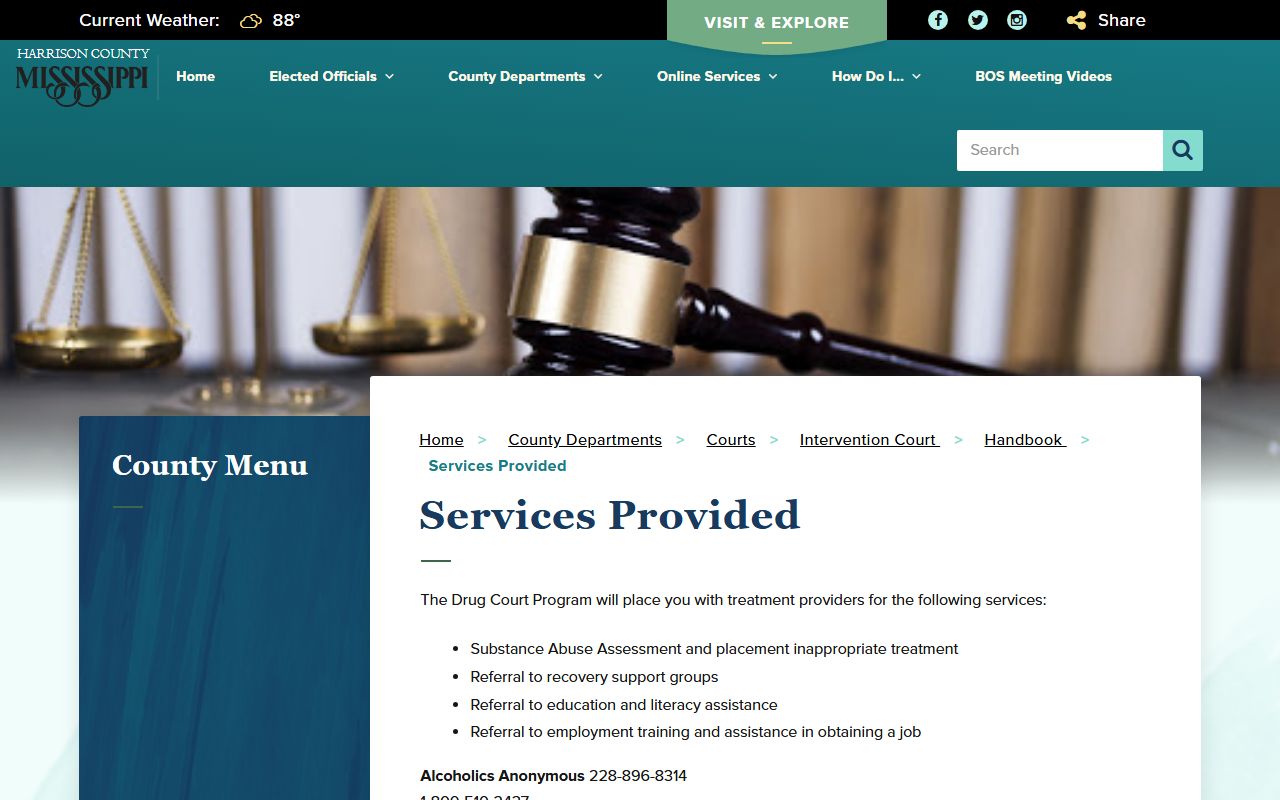
Services include substance-abuse assessment, treatment placement, recovery support referrals, education and literacy help, and job training. These supports sit behind the twice-weekly court calendar that keeps each person accountable.
Note: Drug Court runs every Tuesday and Thursday, so a participant who misses a session risks a failure-to-appear warrant and possible time in jail.